Are you a Mergener?
The Core Name: The monastery was dedicated to St. Mary (Sankt Maria ad Martyres or St. Marien).
The Dialect Shift: Over centuries, the local Trierisch and Moselle-Franconian dialects naturally shortened and shifted the pronunciation of Marien into Mergen.
The Compound Word: When the monastery built its inner-city courtyard, it was called the Marien-Hof (Mary's Court), which the locals pronounced as Mergener Hof. The "-er" suffix in German works just like it does in English (e.g., a New Yorker is from New York)—so Mergener Hof literally translates to "The Courtyard belonging to the Mary folks."
Sankt Maria ad Martyres - Saint Mary of the Martyers
The monastery of St. Mary of the Martyrs (often referred to in historical documents as Sankt Maria ad Martyres, St. Marien, or Sankt Marien am Ufer) was one of the earliest and most influential monastic foundations in Trier. Its timeline stretches from late antiquity into the modern era, directly weaving into the history of the Mergener Hof city estate.Monks, Laborers, and Demographics
Running the Abbey
"To run an 'estate' the size of St. Mergen would require a large amount of labor—how many were Mergeners?, and how many were the Monks? Did any Mergeners become Monks? The list of Abbots don't show a Mergener, how come?. How many people lived in Trier in 1800, and how many were Mergeners?"
1. The Monks vs. The Labor Force: Who Managed What?
Running an estate as vast as Sankt Maria ad Martyres (St. Mergen) required a multi-tiered labor force, structured strictly by class, vows, and tenant contracts. By the late 18th century, Benedictine abbeys operated primarily as corporate agrarian managers rather than mass manual labor forces.
The actual ordained monastic community was small. They did not perform daily, heavy field labor. Instead, they served as executive administrators: the Abbot (CEO), the Cellarer (CFO / Estate Manager), the Infirmarian (Director of Medicine), the Sacristan, and choir monks devoted to the daily Divine Office.
Unordained men (*conversi*) who took simplified vows. They managed the inner workings: the abbey bakery, cellars, blacksmith forge, stables, and administrative estate books.
The physical backbone of the estate—tending the Pomerium orchards, working the Scharzhofberg wine slopes, and managing river shipping—consisted of local lay families living in Trier-Nord, Euren, Eitelsbach, Wasserliesch, and surrounding parish villages. These tenant farmers (*Hintersassen*) and vineyard workers (*Winzer*) took their surname directly from the monastery over generations of service.
2. Did Any Mergeners Become Monks?
You will not find a "Mergener" on the official List of Abbots (*Abtsreihe*), and this reflects the rigid class structure of the Holy Roman Empire:
- Why No Mergener Abbots? In the Holy Roman Empire, the office of Abbot (*Abbas*) was a high-ranking ecclesiastical and political office. Abbots were chosen almost exclusively from noble dynasties (*Adel*), high patrician families of Trier, or prominent clerical scholars sent from regional ecclesiastical centers.
- Choir Monks: Becoming a full choir monk required a substantial "entry dowry" or family wealth to fund seminary studies, making it rare for tenant farming families to reach this rank.
- Lay Brothers (*Conversi*): Yes. Local men carrying the family name frequently served as *conversi* (lay brothers) or parish priests (*Pfarrer*) in outlying abbey-owned churches, taking vows of service to maintain the estate's practical operations.
3. Population of Trier in 1800 & The Mergener Share
Based on the official French imperial census of 1801, Trier had shrunk dramatically from its ancient Roman peak of 80,000. By 1800, after centuries of regional wars and French Revolutionary occupation, Trier was a compact, walled cathedral city surrounded by agricultural hamlets.
French census records (*Recensement de 1802/1806*) and parish registers (*Kirchenbücher*) across St. Paulin, St. Gervasius, and surrounding Moselle villages show roughly 15 to 25 distinct household heads carrying the surname *Mergener* (or variants like *Märgener*). With typical 19th-century family sizes, they represented approximately 1% to 1.5% of the localized parish population—a tight-knit clan anchored directly to the abbey's lands.
Chronological outline of its origins and development:
Late Antiquity & Foundations (4th–7th Century) c. 4th Century — The Roman Cemetery: Outside the northern Roman city walls of Augusta Treverorum (Trier), an early Christian burial site forms. It is tightly associated with local Christian martyrs, laying the spiritual foundation for the site's future dedication to the Virgin Mary and the Martyrs.
c. 6th–7th Century — The First Monastery: During the early Frankish Merovingian period, a monastic community is officially established at this site along the banks of the Moselle River (ad ripa). It serves as a sanctuary and place of prayer near the martyrs' graves.
High Middle Ages & Growth (10th–13th Century) 882 — Viking Destruction: Like much of Trier, the early riverside monastery is plundered and heavily damaged during devastating Viking raids along the Moselle.
c. 950–1000 — Imperial and Archepiscopal Rebuilding: Under the Ottonian dynasty and influential Archbishops of Trier, the abbey is reconstructed, expanding into a prominent Benedictine monastery.
1017 — Formal Endowments: Papal and regional charters formally secure the legal and structural independence of the Abbey of St. Maria ad Martyres.
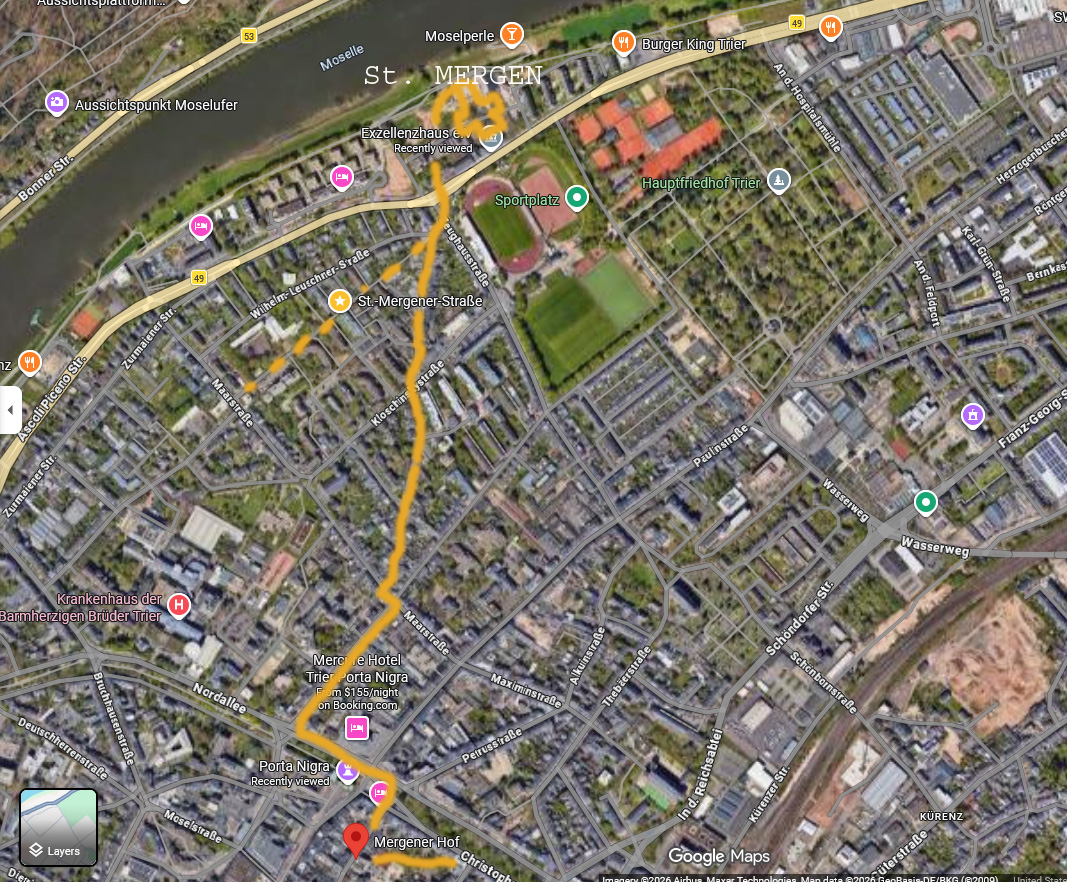
1283 — Establishing the City Estate: Needing a secure base inside the fortified city walls in case of siege or flooding, the monastery acquires an inner-city property. This estate becomes known in the local dialect as "Mergen" (from Marien), founding the Mergener Hof.
Early Modern Era to Dissolution (18th–19th Century) c. 1765 — The "Nells Ländchen" Expansion: Reflecting late-Baroque prosperity, the Abbey expands its estate holdings just north of the city, constructing the Gutshaus D'Ham (an estate house later known as Nells Park or Nells Ländchen).
1794 — French Revolutionary Occupation: French troops occupy the Rhineland. The monastic properties are seized, and religious operations are severely restricted.
1802–1803 — Napoleonic Secularization: Under Napoleon’s secularization decrees, the Benedictine Abbey of St. Mary of the Martyrs is officially dissolved. The riverside monastic buildings are broken up, and their sprawling estates (including the inner-city Mergener Hof and the Nells parklands) are auctioned off into private hands, marking the definitive end of the historic abbey.
Mergener Hof
The Mergener Hof is a historic building complex located in Trier, Germany, with roots that stretch back to the Middle Ages.Its evolution moves from a monastic sanctuary to an influential Jesuit youth hub and modern cultural center.
Here is a short outline of its origins and history:
1. Medieval Origins & Monastic Refuge (13th–15th Century) First Record (1283): The estate is first documented in historical records in the late 13th century.
The "Mergen" Name (1454): In 1454, the property became a Stadtrefugium (city refuge or estate) for the Abbey of St. Mary (Kloster St. Marien), which was located just outside the city walls. In the local dialect, "Marien" evolved into "Mergen," giving the estate its lasting name: Mergener Hof (Mary's Court).
2. Renaissance Reconstruction & Secularization (17th–19th Century) Current Structure (Early 1600s): The architectural complex standing today on Rindertanzstraße was primarily built in its present form at the beginning of the 17th century.
Napoleonic Era: Following the French Revolution and Napoleon's subsequent annexation of the region, the property was secularized and fell into private hands during the early 1800s.
3. The Jesuit Connection & Youth Movement (20th Century) The MJC Legacy (1617 / 1919): In 1617, the Jesuits in Trier established a youth craft guild and sodality, eventually known as the Marianische Jünglings-Congregation (MJC). After navigating centuries of suppressions (including Bismarck's Kulturkampf), the Jesuits re-established a permanent presence in Trier in 1919.
Acquisition (1930): The Jesuits officially purchased the Mergener Hof in 1930 to serve as a dedicated Jugendhaus (youth center) for the MJC.
WWII Seizure: In 1937, the Nazi regime dissolved the association and confiscated the property, placing it under state control.
4. Post-War Revival to Present Day Return to Youth Work: After World War II, the property reverted back to church-associated use. By the 1960s, the Jesuits returned to revitalize the space, expanding their outreach to include open community youth work and welcoming young women into the organization.
Modern Identity (1971): The official association name was formally updated to Mergener Hof e.V. (MJC von 1617) zu Trier.
Today, while firmly anchored in its 400-year-old Jesuit youth advocacy tradition, the historic complex is well-known regionally as a vibrant cultural center, social hotspot, and live music venue.


Comments
Post a Comment